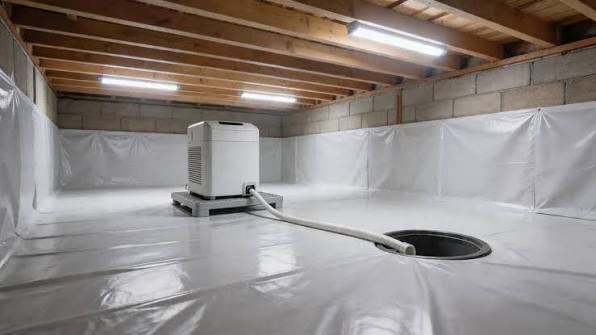
The smell usually gives it away first: a musty, earthy odor rising through the floorboards, strongest after rain. Inside the crawl space the picture is clearer — soil that never quite dries, condensation beading on pipes and ductwork, insulation hanging heavy, and humidity readings of 65 to 70 percent week after week.
That is persistent ground dampness, and it is a load problem, not just a humidity problem. Moisture enters continuously from the soil, foundation walls, and humid outdoor air. Correct crawl space dehumidifier sizing means matching the machine to that load: an undersized unit runs constantly, wastes power, and still never reaches a safe level.
How to Size a Crawl Space Dehumidifier: The Direct Answer
Size a crawl space dehumidifier by its AHAM-rated pints per day, matched first to square footage, then adjusted for dampness. A damp crawl space needs roughly 50 AHAM pints per day at 500 square feet, 70 pints at 1,000 square feet, 90 pints at 1,500 square feet, and 120 pints at 2,000 square feet. Step up one size if the space is very wet, tall, vented rather than sealed, or divided into sections air moves through poorly. Set the humidistat near 50 percent relative humidity — and never buy on a saturation rating alone.
What Pints Per Day Really Means for Crawl Space Dehumidifier Sizing
Capacity is measured in pints per day (PPD): the water, in U.S. pints, a unit removes in 24 hours under a stated test condition. A 70-pint unit at full rating removes about 8.75 gallons a day. The test condition matters as much as the number: the same machine earns very different figures at different temperatures and humidity.
AHAM vs. Saturation Pint Ratings: The Comparison That Matters
The AHAM rating, from the Association of Home Appliance Manufacturers, is measured at 80°F and 60 percent relative humidity — close to real crawl space conditions. A saturation rating is measured at or near 100 percent humidity, in warmer air holding far more moisture, so the unit looks far stronger: one well-known compact model rated at 70 pints at AHAM is listed at 140 pints at saturation, and many budget “70-pint” units deliver only about 35 pints at AHAM. Compare AHAM to AHAM. Portable units use another test: since a 2019 Department of Energy change (80°F down to 65°F), an old portable “70-pint” model is rated at roughly 50 pints today. Dedicated units from AprilAire, Santa Fe, and AlorAir are generally specified at AHAM — the basis for all sizing guidance here.
Square Footage vs. Cubic Footage in Dehumidifier Capacity by Square Footage
Square footage — length multiplied by width — is the starting point for every sizing chart, because footprint tracks the damp ground area beneath the house. It is not the whole story. A 1,200-square-foot crawl space with 2 feet of clearance holds about 2,400 cubic feet of air; with 5 feet of clearance it holds 6,000 cubic feet — more air to dry and slower air movement in the far corners.
When Height, Partitions, and Layout Push You Up a Size
Treat square footage as the base; volume and layout adjust it. Manufacturers publish both — one 110-pint AHAM model is sized for up to about 3,600 square feet or 16,800 cubic feet. Step up one size when any of these apply:
- Tall clearance: average height above about 4 feet, raising the air volume well beyond the footprint.
- Partitioned layout: foundation walls, piers, or additions dividing the space into pockets dry air cannot reach.
- Long, narrow shape: an L-shaped or stretched footprint where one unit cannot circulate air to the far end without ducting.
How Damp Is Your Crawl Space? Damp, Very Damp, and Wet Are Different Loads
- Damp: humidity usually 55 to 70 percent, a musty smell, soil cool and slightly moist, with no visible water. Use the baseline capacity for your square footage.
- Very damp: humidity regularly 70 to 85 percent, condensation on pipes, ducts, and walls, and damp patches on soil or masonry. Step up one size — roughly 10 to 20 additional AHAM pints.
- Wet: standing water, active seepage, or humidity persistently above 85 percent. Do not size your way out of this: fix the water first, then size for the load that remains.
A Step-by-Step Crawl Space Dehumidifier Sizing Method
This six-step process turns the ideas above into a specific pint capacity for your home:
Measure the footprint. Multiply length by width for each section, add the sections together, and note the average clearance height.
Rate the dampness. With a hygrometer and a visual inspection, class the space as damp, very damp, or wet.
Fix bulk water first. If the space is wet, correct grading, gutters, downspouts, plumbing leaks, and standing water before choosing a unit.
Start from the size chart. Find the baseline AHAM capacity for your square footage and dampness level in the chart below.
Apply the step-ups. Add one size for tall clearance, a partitioned layout, a vented space, or a hot, humid climate.
Check the rating and the fit. Confirm each shortlisted model’s AHAM pints, height, temperature range, and drainage options before buying.
Crawl Space Dehumidifier Size Chart by Square Footage
The crawl space dehumidifier size chart below gives starting ranges in AHAM pints per day — not saturation pints — for a sealed crawl space with a ground vapor barrier. With persistent ground dampness, start in the middle of your row. The ranges are practical estimates from manufacturer sizing guidance, not guarantees: a tall or divided space can push a home into the next row.
Worked Example: A 1,000-Square-Foot Crawl Space With Ground Dampness
A 1,000-square-foot crawl space, readings around 72 percent, and summer condensation on the ducts is very damp, not merely damp. The chart points to about 90 AHAM pints per day. A unit advertised as “90 pints” at saturation but rated near 45 pints at AHAM is roughly half the machine this space needs. At 2,000 square feet, start from about 120 AHAM pints and step up for venting or climate.
Fix the Water First: Why Sizing Cannot Outrun Ground Dampness
A dehumidifier removes water vapor from air. It cannot evaporate puddles or compete with rainwater entering through a foundation crack. Every pint of capacity works harder — and costs more to run — if these basic controls are missing:
- Exterior drainage: soil graded away from the foundation, gutters clear, downspouts discharging well away from the house.
- Ground vapor barrier: polyethylene sheeting over the soil — 6-mil minimum, thicker reinforced 10- to 20-mil liners last longer — with seams overlapped and sealed and edges run up walls and piers.
- Sealed vents and penetrations: foundation vents closed and sealed, so the unit is not fighting humid outdoor air all summer.
- Plumbing and sump checks: leaks repaired and, where groundwater rises into the space, a sump system handling liquid water first.
Drainage and Condensate Pump Planning for a Crawl Space Dehumidifier
A correctly sized unit removes several gallons of water a day, and that water must leave continuously and automatically. A bucket emptied by hand is not a drainage plan in a space entered a few times a year. Plan drainage and the condensate pump arrangement alongside the size, because the drain route often decides where the unit can sit.
Gravity Drain vs. Condensate Pump
A gravity drain is simplest when a floor drain, sump basin, or plumbing drain sits below the unit, so the hose runs downhill with no low spots. Most crawl spaces offer no such drain, which is why drainage and a condensate pump for a crawl space dehumidifier are so often paired. A built-in or external pump lifts water vertically — commonly about 15 to 20 feet of lift — and pushes it to a drain or outside. Check the rated lift against your route, keep the line short, and follow the manufacturer’s check-valve guidance.
Placement, Airflow, and Clearance
Set the unit on a level pad, or hang it from the joists where clearance is tight, keeping intake and discharge clear of walls, piers, and stored items. A central position suits a compact space; in a long or divided space, discharge ducting or a second unit prevents a dry island around the machine and damp corners elsewhere. Check unit height against your clearance before ordering — 18 to 24 inches is common. Choose automatic defrost and a stated low-temperature range, since a cold coil can ice over and quietly destroy real-world capacity.
Energy Efficiency, Running Costs, and What Correct Sizing Saves
Efficiency is expressed as an energy factor or integrated energy factor: liters of water removed per kilowatt-hour. Higher is better. As an estimate, a unit drawing around 500 to 700 watts and running 10 to 14 hours a day in the humid season uses roughly 150 to 300 kilowatt-hours a month — about $25 to $45 at an illustrative $0.15 per kilowatt-hour. Correct sizing is itself an energy measure: an undersized unit runs almost continuously, while a properly sized unit cycles off. Dedicated crawl space dehumidifiers commonly fall in an estimated $800 to $2,000-plus range, with professional installation often adding an estimated $500 to $1,500 — planning estimates, not quotes.
Common Crawl Space Dehumidifier Sizing Mistakes and How to Avoid Them
Most disappointing installations trace back to one of these avoidable errors:
- Buying the saturation number. A “120-pint” headline that is really 55 to 60 AHAM pints leaves the space permanently under-dried. Always size from the AHAM rating.
- Sizing on square footage alone. Ignoring height, partitions, venting, and dampness understates the real load.
- No continuous drainage. A small internal tank fills within a day or two; the unit shuts off and humidity rebounds.
Maintenance That Protects the Capacity You Paid For
Rated capacity assumes clean airflow. Dust loads the filter steadily, and a clogged filter quietly turns a correctly sized unit into an undersized one. Rinse or replace the filter on the manufacturer’s schedule — commonly every few months. Confirm the pump discharges, clear algae or sediment from the hose, and verify humidity with an independent hygrometer rather than trusting the built-in display.
Safety Notes and When a Professional Is Needed
Follow the manufacturer’s clearances and use a properly grounded outlet; never run the unit on a lightweight extension cord. New circuits, hardwired work, and plumbing tie-ins belong to a licensed electrician or plumber where local rules require it. Hire a professional if you find extensive mold, rotted or sagging joists, unexplained standing water, sewage contamination, or damaged wiring — remediation, structural repair, and electrical work are not sizing problems.
Final Thoughts
Good crawl space dehumidifier sizing is a short chain of honest decisions: measure, rate the dampness honestly, fix bulk water first, start from the chart’s AHAM pints, and step up only for a named reason — height, partitions, venting, or climate. Plan continuous drainage, then verify with a hygrometer over the first weeks. If humidity will not hold near 50 percent, recheck the drain, filter, and vapor barrier.
Frequently Asked Questions
What size dehumidifier do I need for a 1,000 sq. ft. crawl space?
Start at about 70 AHAM pints per day for a damp space. If it is very damp — regular condensation, readings in the 70s or 80s, damp soil — step up to about 90 AHAM pints. Confirm the figure is the AHAM rating, not saturation, which can be roughly double.
How many pints should a dehumidifier remove for a crawl space in a day?
Most single-family crawl spaces land between 50 and 145 AHAM pints per day: about 50 pints for a small, damp space under 500 square feet, rising to 120 or more at 2,000 square feet or in very damp conditions. Large, divided spaces often do better with two units.
Is it better to oversize a crawl space dehumidifier?
Slight oversizing for a stated reason — very damp conditions, tall clearance, a vented layout — is sensible, because the unit reaches its set point and cycles off. Gross oversizing costs more and can short-cycle, giving uneven control.
Do I need a condensate pump with a crawl space dehumidifier?
Yes, whenever the drain point sits above the unit or too far for a downhill gravity hose — most crawl spaces. The pump lifts condensate to a drain or outside automatically. If a drain sits below the unit, gravity is simpler and more reliable.
Can a dehumidifier fix standing water in a crawl space?
No. A dehumidifier removes water vapor from air; it cannot correct standing water or seepage. Fix grading, gutters, leaks, or groundwater entry first — with a sump system if needed — then let a correctly sized unit control the remaining humidity.