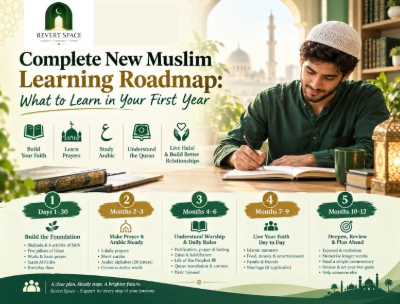
Your first year as a Muslim comes with a huge amount to learn and very little guidance on where to begin.
Prayer, Arabic, the Quran, halal living, and relationships all compete for your attention at once.
A free step-by-step Islamic course for new Muslims solves this by putting each topic in a sensible order, so you build on what you already know.
At Revert Space, we have supported more than 500 new Muslims, and one pattern repeats: people who follow a simple plan stay motivated, while people who try to learn everything at once feel overwhelmed. This roadmap breaks the first twelve months into five clear phases.
Why a Roadmap Matters
Islam is a vast subject. Pew Research Center estimated roughly 2 billion Muslims worldwide in 2020, with many different cultures, languages, and traditions. That variety is a strength, but it can leave a newcomer unsure which advice to follow first.
Pew also found that global Muslim population growth comes mostly from age structure and birth rates, with conversion playing a small role. In practice, many reverts learn without a Muslim family to guide them. A roadmap fills that gap.
Learning research also supports a gradual approach. Short, regular study sessions spread across weeks tend to stick better than long cramming sessions, which is why this plan favours small daily habits over big weekend marathons.
Phase 1: The First 30 Days, Build the Foundation
Your first month covers the essentials only. Focus on:
- The meaning of the Shahada and the six articles of faith
- A simple overview of the five pillars of Islam
- How to perform wudu and the basic steps of prayer
- Surah Al-Fatiha, the seven-verse opening chapter recited in every prayer
- A few everyday duas, such as before eating and before sleep
Revert Space’s free Life After Shahada: First 30 Days Guide gives you a daily structure for this month.
Phase 2: Months 2 and 3, Make Prayer and Arabic Steady
Once the basics feel familiar, turn them into habits:
- Pray all five daily prayers, even if you read the words from a transliteration at first
- Learn two or three short surahs from the end of the Quran
- Start the Arabic alphabet, which has 28 letters, and practise a few minutes each day
- Learn the most common Arabic words you hear in prayer and conversation
If you are unsure what to prioritise, this guide to Arabic words every new Muslim should learn first gives a practical starting list. For prayer, read what to learn about Salah first so you do not overload yourself.
Phase 3: Months 4 to 6, Understand Worship and Daily Rules
With prayer in place, you can study the reasoning behind it. This is the right time to learn:
- The rules of purification, prayer, and fasting in more detail
- What zakat is and who it applies to
- The basics of halal and haram
- A short introduction to the life of the Prophet ﷺ
- How to read a Quran translation with context, starting with short sections
The free Fiqh for Beginners course explains these topics in plain language for people starting from zero. If reading Arabic is still a barrier, the Qur’an Reading Program takes you from no Arabic to confident reading, step by step.
The Quran has 114 surahs divided into 30 equal parts called juz, which makes long-term reading goals easy to measure. A page or two a day adds up faster than most beginners expect.
Be careful about where you get rulings. Different schools of thought sometimes give different answers, so ask a qualified teacher or mentor when a question affects your daily life.
Phase 4: Months 7 to 9, Live Your Faith Day to Day
By now you know the basics, so shift towards character and lifestyle. Useful topics include:
- Manners with family, neighbours, and coworkers
- Handling food, money, and entertainment in line with your values
- Managing relationships with non-Muslim family and friends
- Marriage, if it applies to your situation
Islamic manners shape how others see you and how you feel. The Adab and Etiquettes in Islam course covers this area in a simple, practical way. For everyday changes at home, the Halal Living Setup service offers guidance without pressure.
Phase 5: Months 10 to 12, Deepen, Review, and Plan Ahead
The final stretch is about depth and consolidation:
- Begin learning basic tajweed, the rules of Quran recitation
- Memorise a few longer surahs or a page of the Quran
- Read a beginner-friendly commentary on a short surah
- Review everything you have learned and note the gaps
- Set goals for year two, such as deeper Arabic or a regular study circle
This is also a good time to help someone newer than you. Teaching reinforces what you know and builds community.
How to Choose Reliable Learning Resources
Free and paid options are everywhere, so check quality before you commit. Look for:
- Teachers or reviewers with verifiable Islamic training
- A clear order of topics designed for beginners
- Answers that cite the Quran and authentic sources instead of personal opinion
- A welcoming tone with no pressure, shaming, or demands for money
- A way to ask questions, whether through a mentor, class, or community
Online learning suits many new Muslims because it fits around work and family and reaches people far from a mosque. It works best when paired with at least one real person who can answer questions.
A Simple Weekly Study Rhythm
Consistency matters more than long sessions. A realistic pattern looks like this:
- Daily: 10 to 15 minutes of Quran, Arabic, or duas, and the five prayers
- Three times a week: one 20 minute lesson from your current phase
- Weekly: one longer session to review, plus time with a mentor or study group
- Monthly: a quick check on what you have learned and what feels unclear
Keep a small notebook for questions. Bring them to a teacher instead of searching random videos, because unverified sources can mislead beginners.
Common Challenges and How to Handle Them
- Information overload. Pick one topic per week. Our list of the daily duas for reverts is a good example of something you can learn one item at a time.
- Comparing yourself to lifelong Muslims. They started earlier. Measure your progress against your own starting point.
- Missing a week. Return to the plan without guilt and continue from where you stopped.
- Conflicting advice. Prefer qualified teachers and trusted organisations over social media comments.
- Hitting a plateau. Progress in Arabic and recitation often feels slow around month four or five. Slow weeks are normal, so keep your daily minutes small and steady until the next step clicks.
- Feeling alone. Study with others. A mentor or class turns a lonely task into a shared one.
An Expert Insight on Your First Year
In our experience at Revert Space, the first three months decide the rhythm for the whole year. New Muslims who secure prayer, a few short surahs, and one weekly connection with a mentor or class usually keep going. Those who chase every topic at once often stop around the second month. Aim for steady progress each week.
Frequently Asked Questions (FAQs)
1. What should a new Muslim learn first?
Start with the meaning of the Shahada, the five pillars of Islam, wudu, the basic steps of prayer, Surah Al-Fatiha, and a few everyday duas. These cover the essentials of the first 30 days and give you a base for everything that follows.
2. How long does it take to learn the basics of Islam as a new Muslim?
Most people can learn the basics of prayer, wudu, and a few short surahs in the first one to three months. A solid foundation in fiqh, Quran reading, and daily manners usually takes closer to a year. Pace varies, so follow a steady plan instead of rushing.
3. Is there a step-by-step Islamic course for new Muslims?
Yes. Revert Space offers free, structured courses for people starting from zero, including a first 30 days guide, Fiqh for Beginners, and Arabic and etiquette courses. They are ordered so each topic builds on the last, with mentor support available.
4. How much time should a new Muslim spend studying each day?
Ten to fifteen minutes a day is enough to start. Add one 20 minute lesson a few times a week and one longer review session each week. Short, regular sessions stick better than occasional long ones.
5. Should a new Muslim learn Arabic and the Quran in the first year?
You do not need fluency, but starting early helps. Begin with the 28 letters of the Arabic alphabet, a few common words, and short surahs. A reading program can then take you toward reading the Quran with confidence.
6. How can I tell if an Islamic learning resource is reliable?
Look for teachers with verifiable Islamic training, a clear beginner-friendly order of topics, and answers that cite the Quran and authentic sources. Avoid sources that pressure you, shame you, or ask for money in unclear ways. A mentor or class where you can ask questions adds an extra layer of trust.
7. What if I miss a week or fall behind on my learning plan?
Return to the plan without guilt and continue from where you stopped. The order of topics matters more than the speed. If a phase takes longer than expected, that is normal.
8. Can I learn Islam online as a new Muslim?
Yes. Online learning fits around work and family and helps people who live far from a mosque. It works best when paired with at least one real person, such as a mentor or study group, who can answer your questions.
Start Your First Year With Support
Twelve months is enough to build a solid base when you have a clear order, small daily habits, and people who can answer your questions. Follow the five phases, adjust the pace to your life, and review each quarter. If a phase takes longer than planned, that is fine, because the order matters more than the speed.
Revert Space offers free structured courses, 1-on-1 mentorship, and a judgment-free community for new Muslims. Join the New Muslim Starter Program and take your first step with guidance.