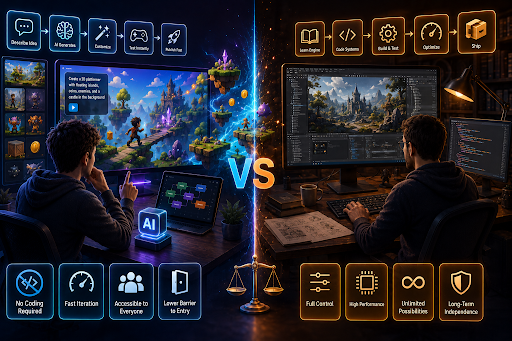
Every creator eventually asks some version of this question: should I learn a traditional engine, or lean into an AI-assisted, no-code approach instead? The honest answer isn’t that one is universally better than the other, it’s that each serves a different kind of creator, a different kind of project, and a different set of priorities. Understanding those differences clearly is more useful than picking a side in the abstract.
What Traditional Tools Actually Offer
Complete Control Over Every System
Engines like Unity or Unreal give you access to everything, physics, rendering, custom systems, with no ceiling on what’s technically possible beyond your own skill and time. If your vision requires something highly specific, traditional tools are built to accommodate that level of customization.
Long-Term Independence From Any Platform
A traditionally built game exists independently of any single company’s continued support. You own the implementation outright, which matters for projects meant to exist and evolve over many years.
Deep Optimization for Demanding Projects
When a game needs to handle thousands of active objects or competitive multiplayer with minimal latency, traditional development gives you direct access to performance techniques that no-code platforms don’t expose in the same way.
The Real Cost: Time and Technical Investment
None of this comes free. Building real competency with a traditional engine takes months or years of consistent effort, and every mechanic, however simple, has to be constructed from lower-level pieces. That investment is substantial, and it’s the main reason traditional tools don’t work for every creator or every project.
What AI Game Makers Actually Offer
Speed From Idea to Playable Version
This is the clearest, most immediate advantage. What might take weeks with a traditional engine can take a single sitting with an AI-assisted platform. AI game maker tools let you describe your concept in plain language and generate a working prototype almost immediately, replacing a long technical build process with a direct, conversational starting point.
Accessibility Without a Technical Background
Writers, artists, and anyone with strong creative instincts but no programming experience have a direct path to building something playable. The idea becomes the primary asset again, since execution no longer depends on a specific technical skill set.
Fast, Cheap Iteration
Because generating a new version costs relatively little time, testing multiple approaches to a mechanic becomes realistic instead of exceptional. That comparison tends to produce stronger design decisions than committing early simply because alternatives were too expensive to build. A game like Formula Mania reflects what that kind of iterative comparison can produce, a racing mechanic tuned through testing multiple approaches rather than a single first guess.
The Real Limit: A Lower Technical Ceiling
Highly custom systems, deeply novel mechanics, or competitive netcode still push against what AI-assisted tools handle reliably. The same accessibility that makes these platforms approachable is also what eventually limits how far a specific, unusual technical vision can be pushed.
Comparing Them Directly
Speed to a Testable First Version
AI game makers win clearly here. A rough, playable prototype comes together in hours rather than weeks.
Long-Term Flexibility and Control
Traditional tools win here. Nothing is technically off-limits, and the project isn’t tied to a platform’s roadmap or continued existence.
Accessibility for Non-Programmers
AI game makers win decisively. No multi-year learning curve stands between a good idea and testing it.
Performance at Serious Scale
Traditional tools still hold the edge for projects pushing genuinely demanding technical limits.
Cost of Testing Whether an Idea Is Fun
AI game makers win by a wide margin. Validating a concept costs a fraction of the time compared to building it manually first.
When Traditional Tools Are the Better Choice
- You have a specific, technically demanding vision that requires custom systems traditional engines are built to support
- Performance at scale is a core requirement of the project, not an afterthought
- You’re building something meant to exist and evolve independently for many years
- You already have, or specifically want to build, deep technical skill as part of your creative practice
When an AI Game Maker Is the Better Choice
- You want to validate whether an idea is genuinely fun before investing months into it
- You don’t have a programming background and don’t want that to gate your creative output
- Iteration speed matters more to you than deep technical customization
- You’re building casual, social, or browser-based games where accessibility and fast load times matter more than heavy technical complexity
The Approach Many Creators Actually Use
A growing number of creators don’t treat this as a permanent, either-or decision. They prototype quickly using an AI-assisted platform, confirm the core mechanic is genuinely fun, and only then decide whether the project warrants a fully custom build using traditional tools. This captures the speed advantage of AI-assisted development without closing off the option to go traditional once an idea has proven itself.
Others stay entirely within AI-assisted platforms because their projects, casual games, social experiences, quick multiplayer titles, never actually run into the specific limitations that would make traditional tools worth the added time investment.
What Doesn’t Change, Regardless of Which You Choose
Design Judgment Still Comes From You
Neither approach automatically produces a good game. Whether a mechanic feels fair, satisfying, or well-paced depends entirely on your own judgment, developed through honest playtesting, regardless of which tool executed the underlying implementation.
Playtesting Still Matters Equally
Fast or slow, accessible or technically demanding, every development approach still requires watching real players interact with your game and adjusting based on what you observe. Neither traditional tools nor AI-assisted platforms replace that fundamental process.
Final Thoughts
Neither AI game makers nor traditional development tools are objectively better for creators in general. Traditional tools offer control and independence at the cost of significant time and technical investment. AI game makers offer speed and accessibility at the cost of a lower technical ceiling. The right choice depends entirely on what you’re building, what resources you’re working with, and what actually matters for your specific project.
The most useful question isn’t which approach wins overall. It’s which one gets your particular idea in front of real players fastest, without sacrificing what that specific idea genuinely needs to work.