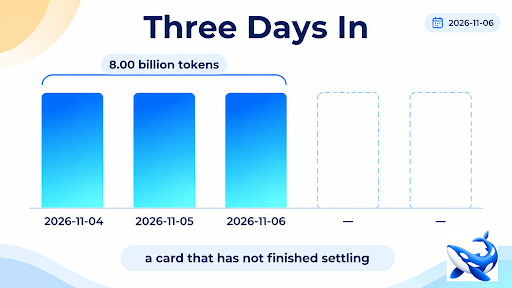
Through OrcaRouter the card has been live for three days and its numbers are still moving. There is a particular kind of number that appears in the first week of a model: large, real, and almost useless for planning. OrcaCyber Hy4 API has one — 8.00 billion tokens in three days, across the seven-day window ending November 5 [OURS]. The card was released on 2026-11-04 at $0.80 in / $1.60 out / $0.15 cache, with a 1,048,576-token context and a 65,536-token output ceiling, behind the security gate on OrcaRouter.
Three days of traffic is enough to say the card is being adopted and not enough to say what it costs to run, because the two numbers that decide a budget — latency and error rate — are still forming. This piece is about reading a card in that state without drawing conclusions it cannot support.
What three days can tell you
The price is fixed. $0.80, $1.60 and $0.15 are catalogue facts, not measurements. They will not move because the card is new.
The context and ceiling are fixed. 1,048,576 tokens in, 65,536 out. Those are product properties.
The modalities are fixed. Text and image in; tools, JSON and reasoning are listed as capabilities. ZDR is not flagged on this card, which is a difference from its siblings worth checking before regulated work.
The volume is real. Eight billion tokens is not curiosity traffic. A curious crowd sends thousands of short prompts; eight billion tokens in three days implies long contexts and pipelines, which means a small number of teams pointed real work at the card within hours of release.
Everything else — p50, p95, throughput, error rate — is provisional.
The two numbers that are still forming
The card’s seven-day p50 is 3,613 ms, its throughput 114.2 tokens per second, and its error rate 19.462% [OURS]. Taken at face value those describe a card that is slow to start and fails one request in five. Neither reading survives contact with how the card works.
The error rate first. Every OrcaCyber card is gated: an account without an engagement, a passkey and accepted terms is rejected before the model is reached, and those rejections count as errors. In the first days of a card, most traffic is people testing access. The base cards show the same effect from the other side — Kimi K3.1 Pro at 15.506% and Claude Fable 5.1 at 35.371% on the same day [OURS]. A 19.5% rate on a gated card released 72 hours ago is an onboarding statistic, not a reliability one.
The latency is a different problem. Three days is not a long enough window for a median to settle, and a median measured while a provider is bringing capacity online tends to move. Zero 1.5’s median went from 1,875 ms to 3,553 ms in four days; DeepSeek 1017’s went from 2,118 ms to 998 ms in the same period [OURS]. Medians on new cards move in both directions by factors, and quoting one without its date is how dashboards lie.
Why the volume number is the useful one
The tokens served is the only figure in the set that measures something the provider cannot fake: demand. Eight billion tokens in three days means the card solved a problem for someone at the moment it appeared.
It also sets an expectation for what the card will look like in a month. A new card’s traffic is dominated by a handful of pipelines that were waiting for it; those pipelines keep running, and the profile they generate becomes the card’s real latency distribution — long requests, large artefact inputs, multi-step loops. If you are evaluating the card, your own workload probably resembles theirs more than it resembles a benchmark.
The base card is the control. Tencent Hy4 preview served 361 million tokens in seven days at 31.8 tokens per second [OURS]. The abliterated variant moved twenty-two times that volume in three days. Whatever the preview was for, the uncensored version is being used for something else.
How to evaluate a three-day-old card
Four steps, in order.
Read the price and the limits, not the telemetry. They are the only settled facts. If the ceiling is too small for the artefact, stop — no amount of benchmark work fixes a 65,536-token ceiling.
Get through the gate before you measure anything. Error rates on the public side of a gated card describe the public side of a gated card.
Run your own p50 and p95 on your own prompts, in your own hours, for a week. A new card’s numbers move; yours will move too, and yours are the ones that matter.
Re-read the card after two weeks. If the throughput has moved by a factor of two, the card you evaluated is not the card you would be buying.
The cost of that evaluation is small. A thousand representative requests at 3,000 input and 800 output tokens each costs $3.68 [OURS] — less than a month of the difference between this card and a more expensive alternative at any real volume.
The two-week checkpoint
Write down what to re-read, and when.
The median and the p95. Both are three-day numbers now. A card that settles at 2,500 ms is a different product from one that settles at 6,000, and the timeout you set today should be revisited when the window is a full week.
The error rate after onboarding. If it falls toward the low single digits, the 19.462% was access traffic. If it stays above ten, the gate is not the explanation and the capacity is.
The throughput at your concurrency. A headline figure measured across all traffic says nothing about what you get when you send twenty parallel requests; measure that yourself, in the hours you actually run.
Whether the volume holds. Three days of adoption can be a launch spike. If week two still shows billions of tokens, the card has a real user base and its serving profile will be shaped by long-running pipelines.
A calendar entry for two weeks out is the cheapest piece of diligence in this whole evaluation.
The takeaway
Eight billion tokens in three days is the most informative number on the OrcaCyber Hy4 card, because it is the one that measures demand rather than a window still settling. The price, context and ceiling are fixed and good; the 19.462% error rate and 3,613 ms median describe gated onboarding traffic and will move. Price it, gate it, measure it yourself, and re-read it in two weeks.