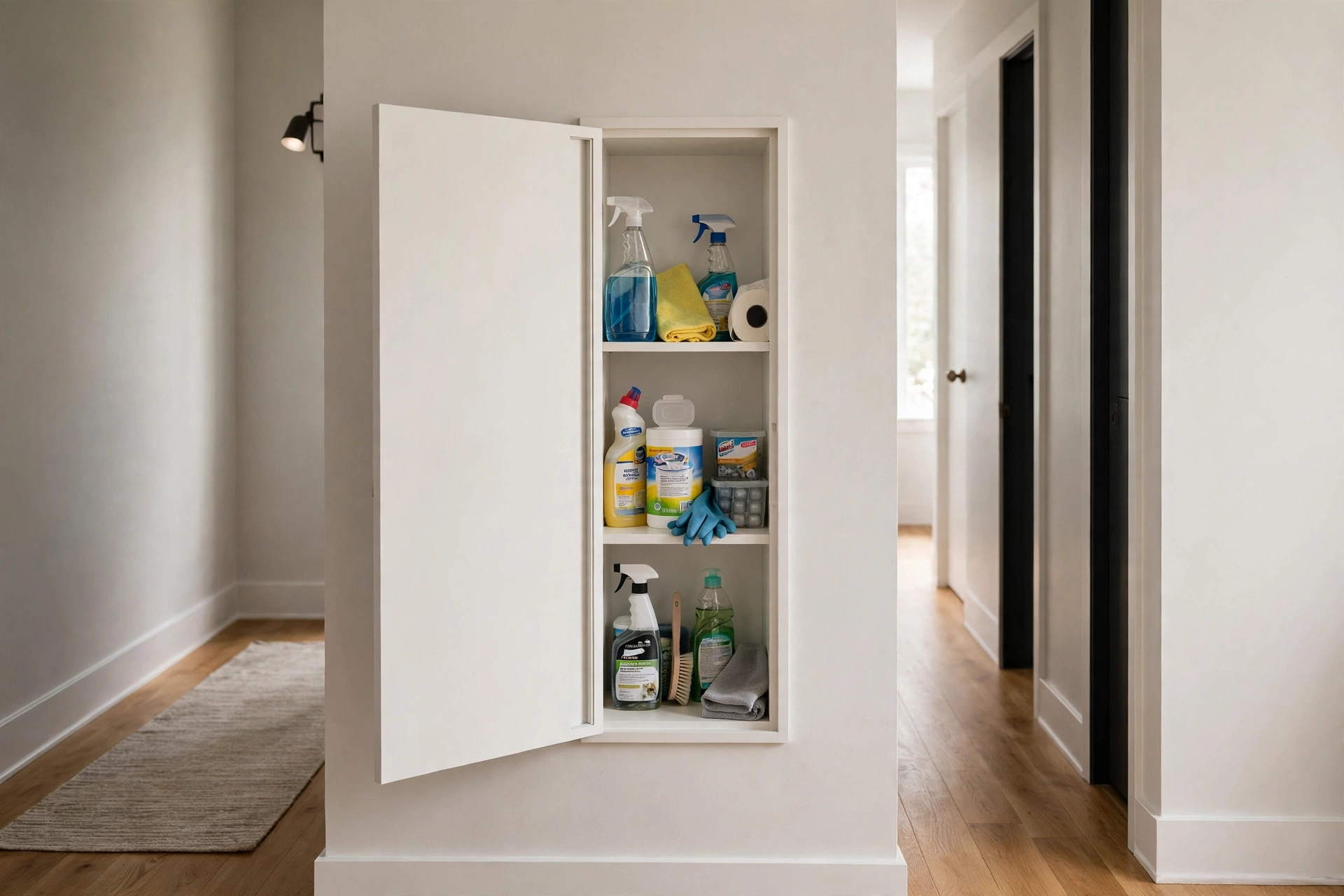
Most homes have cleaning supplies scattered across half a dozen places: a spray bottle under the kitchen sink, a bucket in the laundry room, a mop leaning behind the back door, and a shelf of half-empty bottles in the garage. Nothing is ever where you need it, and the cupboard under the sink is so crowded that bottles fall over every time you reach for one. A recessed household cleaning supply station solves that problem by turning the empty space inside a wall into a dedicated, flush-fitting home for every bottle, brush, and cloth you own.
The short answer is that a recessed cleaning supply station is a shallow cabinet built into the cavity between two wall studs, finished flush with the wall surface so it takes up no floor space and no room depth at all. It holds detergents, sprays, cloths, and small tools exactly where you use them, keeps chemicals away from children and pets, and frees the cupboards you already have for things that genuinely need them. This guide walks through how to find the right wall, size the niche, build it safely, and keep it organised for years.
Why Cleaning Supplies End Up Scattered Across the House
Cleaning supplies spread themselves around a home because no one ever plans a place for them. Kitchens get a cupboard under the sink by default, bathrooms get a shelf above the toilet, and everything else lands wherever there is a gap. The result is that you own three bottles of the same surface spray in three different rooms, and you still cannot find one when you need it. Each room ends up with its own small stash, and none of them is complete.
What a Recessed Cleaning Supply Station Actually Is
A recessed cleaning supply station is a shallow storage niche built into the depth of a wall, usually between two studs in a standard timber-framed or stud partition wall. The cavity is roughly 90 to 100 millimetres deep in a typical internal wall, which is enough for spray bottles, cloths, gloves, and small caddies, though not for a full-size mop bucket. The front is finished with a flush door or an open framed opening, so the station reads as part of the wall rather than as a piece of furniture stuck onto it.
Finding the Right Wall Cavity for Your Recessed Station
The best wall for a recessed station is an internal stud wall in or near the room where cleaning happens most, which is usually the laundry room, the kitchen, or a hallway close to both. The wall must be a partition you are allowed to open up, not a load-bearing wall, and it must be free of pipes, cables, and ductwork in the section you plan to use. A stud finder and a small inspection hole will tell you more in ten minutes than any amount of guessing from the outside.
- Check the stud spacing first: standard studs sit about 400 or 600 millimetres apart, and a single bay between two studs makes a neat, ready-made niche width.
- Avoid walls with plumbing: walls behind sinks, toilets, and washing machines often carry supply pipes and waste runs that leave no room for a niche.
- Stay clear of electrical runs: switch drops and socket circuits run vertically through studs, so check with a cable detector before cutting.
- Pick a spot at eye level: the centre of the station should sit around 1,400 to 1,500 millimetres from the floor so bottles are visible without a step stool.
- Think about the door swing: a station in a narrow hallway needs a flush or sliding door, because a hinged door opening into the walkway will get in the way.
If no internal wall works, a shallow station can also be built into a deeper wall, such as the side of a built-in wardrobe or the end panel of a kitchen run, using the same recessed principle. The key is to choose a location that is on the natural route between the rooms you clean, so reaching for supplies becomes part of the routine instead of a detour. A station hidden in a rarely visited corner will stay empty, however well it is built.
Sizing the Niche Around the Bottles You Actually Own
Before cutting anything, gather every cleaning product you actually use and line them up on a table. Measure the tallest bottle, usually a spray bottle at around 300 millimetres, and the widest group of bottles you want on one shelf. Most households find that a niche about 500 millimetres wide and 800 millimetres tall, divided into three shelves, holds a full working set of supplies with room to spare. Going bigger is tempting, but an oversized niche is harder to frame neatly and invites clutter to creep back in.
Shelf spacing matters more than overall size. Adjustable shelves, or shelves set at staggered heights, let you keep tall spray bottles on one level and short jars and cloths on another, so no space is wasted above short items. Leave at least 30 millimetres of clearance above the tallest bottle on each shelf, or you will have to tilt bottles to get them out and they will drip. A small lip on the front edge of each shelf, just 15 millimetres high, stops bottles sliding forward when the door closes.
| Niche size | Best for | Watch out for |
|---|---|---|
| Single stud bay, about 400 mm wide | One room’s daily supplies and sprays | Tall bottles may need a taller bay |
| Double stud bay, about 800 mm wide | A whole-house supply station with zones | Needs a header and sill framed in properly |
| Tall narrow bay, 300 mm wide | Hallways and small laundry rooms | Shelves must be shallow to stay reachable |
| Wide shallow bay in a wardrobe side | Homes with no suitable stud wall | Check the wardrobe depth before cutting |
Keeping Chemicals Safe Behind a Flush Door
A cleaning supply station concentrates chemicals in one place, so the door is a safety feature, not just a cosmetic one. In a home with small children or pets, fit a magnetic childproof catch or a small lock on the door, and keep the most hazardous products, such as bleach and drain cleaner, on the highest shelf. The door should close firmly enough that a toddler cannot pull it open, but open easily with one hand when yours are full of laundry.
Store products upright, never on their sides, and never decant chemicals into unlabelled bottles. If you do transfer a product, label the new container with the product name and keep the original packaging for the safety instructions. Keep incompatible chemicals apart, particularly bleach and anything containing ammonia or acid, because mixing them can release dangerous gases. A simple rule that prevents most accidents is to store each product in its original container, with its label facing out, on a shelf you can see without moving anything else.
Ventilation and Moisture Control Inside a Closed Niche
A closed niche in a laundry room or bathroom can trap humidity, and damp air makes cardboard packaging go soft and metal triggers corrode. The simplest fix is to leave a small gap at the top and bottom of the door, or to fit a slim vent grille in the door itself, so air can circulate through the cavity. In a laundry room with a tumble dryer, position the station away from the direct steam path, and avoid building it into a wall that backs onto a shower, where condensation is a constant problem.
Lighting and Labelling That Make the Station Usable
A station that is dark inside will not get used, because nobody can find the right bottle without pulling everything out. A small battery-powered LED strip or a motion-sensor puck light fitted to the top of the niche costs very little and makes every shelf readable at a glance. If the station is near a power source, a wired LED strip on a door switch is even better, because the light comes on the moment the door opens and switches off when it closes.
Labelling turns a tidy niche into a system the whole household can follow. Group products by job, such as kitchen surfaces, bathroom, floors, and laundry, and put a small label on the shelf edge for each group. Keep a short inventory list on the inside of the door, and mark a bottle when it is running low, so the next shopping trip replaces it before it runs out. These small habits take seconds and are what stop the station slowly turning back into a jumbled cupboard.
- Label by task, not by brand: a shelf marked for bathroom cleaning is useful to everyone, while a shelf of brand names means nothing to a guest or a teenager.
- Keep a small step-by-step card: a short note on the door reminding the household where cloths and gloves live saves repeated questions.
- Use clear containers for refills: a clear bottle shows at a glance how much is left, so nothing runs out mid-clean.
Good lighting and clear labels also make the station safer, because nobody has to guess which bottle they are holding. In a hurry, a misread label is how the wrong chemical ends up on the wrong surface, and a well-lit, well-labelled niche makes that mistake far less likely. Treat the inside of the door as the control panel for the whole system, and keep it as tidy as the shelves themselves.
Building the Station During a Renovation vs Retrofitting Later
Building a recessed station during a renovation is straightforward, because the wall is already open and the framing, lining, and finishing happen in the natural order of the job. The carpenter frames the opening, the electrician adds a light if needed, and the plasterer finishes the edges, all in a day or two of work. The cost is mostly labour, and the materials are modest: a few lengths of timber, a sheet of moisture-resistant board, shelves, and a door.
| Approach | Effort | Best time to do it |
|---|---|---|
| During a renovation | Low extra effort, wall already open | Laundry or kitchen refit |
| Retrofit into a finished wall | One to two days, some making good | Any time, with careful inspection first |
| Built into new studwork | Part of the framing job | Extensions and loft conversions |
| Surface-mounted shallow cabinet | Half a day, no cutting | Rented homes or solid walls |
Daily Habits That Keep the Station Working
A recessed station only stays useful if the household treats it as the one home for cleaning supplies. The rule that makes it work is simple: every bottle returns to its shelf after use, and nothing new gets stored anywhere else. When a bottle is empty, it goes straight into recycling and the replacement goes into the station, not onto a windowsill or the top of the washing machine. Within a few weeks, reaching for the station becomes automatic, and the old scattered stashes disappear on their own.
Give the station a quick tidy once a month, which takes about five minutes. Check for leaks, throw away anything that has gone off or lost its label, wipe the shelves, and check that the door catch still holds. A monthly check also catches the slow creep of extra bottles, such as free samples and half-used products from other rooms, before they take over the shelves. A station that is checked monthly stays a station, while one that is never checked quietly becomes just another crowded cupboard.
Recessed Cleaning Supply Station Questions Homeowners Ask Before Building One
Can I build a recessed cleaning supply station in a solid brick wall?
A solid brick wall has no stud cavity to use, so a true recessed niche would need a channel chased into the brickwork, which is messy and weakens the wall. A better option is a shallow surface-mounted cabinet with a slim profile, or a recessed station built into a stud partition elsewhere in the room. If you do chase a solid wall, keep the channel shallow, avoid load-bearing sections, and get a builder to check the wall first.
How deep can a recessed cleaning supply station be?
In a standard internal stud wall the cavity is about 90 to 100 millimetres deep, and the niche should not go deeper than the studs allow. Cutting into the studs to gain depth weakens the wall and is not worth doing for a few extra centimetres. If you need more depth, build the station into a deeper wall, such as a wardrobe side, or accept a shallow niche and keep bulky items like mop buckets elsewhere.
Will a recessed station weaken the wall it is built into?
A single-bay niche in a non-load-bearing partition is safe when it is framed properly with a header above and a sill below, because the load path around the opening is preserved. Problems arise when studs are cut without adding framing, or when several bays are opened in the same wall. Never cut into a load-bearing wall without a structural engineer checking the plan first.
What should I do about cleaning products that do not fit in the niche?
Keep bulky items such as mop buckets, vacuum cleaners, and large refill containers in a separate store, ideally a garage, utility cupboard, or under-stair space. The recessed station is for the daily-use bottles, cloths, and small tools you reach for most often. Decanting refills into smaller bottles that do fit is a practical compromise that keeps the station complete without overloading it.
How do I keep the station from smelling of chemicals?
A small vent gap in the door and moisture-resistant lining will handle most odours, because the smell usually comes from damp air trapped in a sealed niche rather than from the products themselves. Keep lids tightly closed, wipe up any drips straight away, and avoid storing open containers. If a smell persists after ventilating, check for a leaking bottle, which is the most common cause.
Final Thoughts: A Recessed Cleaning Supply Station That Earns Its Wall Space
A recessed cleaning supply station is one of those small home improvements that pays for itself in daily convenience. It takes space that was doing nothing, turns it into the single organised home for every cleaning product you own, and frees your cupboards for things that genuinely need them. Built with care, ventilated properly, and kept to a simple one-home rule, it stays tidy for years and makes the whole house easier to clean. The wall space it uses was empty anyway, and now it works as hard as any cupboard in the house.